How Do We Heal, Really? A Deeper Look at What Gets in the Way
If you’ve been following this series, we’ve already explored how trauma can shape our deep beliefs and inner patterns, and how we can begin changing those limiting beliefs.
How Trauma Impacts Deep Beliefs – and How to Change Them
How to Change Limiting Beliefs from Trauma, Part 2
Now let’s look at this question: how do we actually heal, and what gets in the way?
A client asked a question in a session last month that brought me back to the themes of my last two blogs. It got me thinking that it would be a good way to wrap up this series: How do we heal, really? And what gets in the way?
Some of you may remember Carolyn Myss and one of her big themes, Why People Don’t Heal. It’s a question I’ve thought about a lot over the years, both personally and in my work with clients.
After more than 30 years of working in this field, I’ve seen some common patterns in what gets in the way of healing, as well as what genuinely helps. And while we’re all different, there are some important principles worth exploring.
I also believe most of us have something to heal from. We develop beliefs about ourselves, other people, and the world based on our experiences, particularly the difficult or traumatic ones. Sometimes those beliefs served us at one point in our lives, but they don’t necessarily serve who we’re becoming.
So let’s look at what might be keeping us stuck, and what can help us move forward.
What Gets in the Way of Healing? Avoidance Is a Big One.
One of the biggest obstacles I see is avoidance. I wrote a book about stress management, and this is something I’ve seen over and over again in that work, too.
Let’s just say it plainly: avoiding something that needs attention will eventually bite you in the ass.
Of course, avoidance is a natural first response. We don’t want to feel uncomfortable, face conflict, or look at something that might be painful. We tell ourselves that if we don’t think about it, talk about it, or deal with it, we’ll feel better. And sometimes, in the short term, we do.
But eventually, what we’re avoiding tends to show up somewhere else.
It might be a troubled relationship that we don’t want to examine. It might be other relationship issues, unresolved feelings, or something much more personal. For me, I’m always working on my relationship with food and nourishment, as well as allowing myself to relax. I grew up in a very busy household with lots of kids, as the second oldest, so I learned some patterns around being busy and taking care of things that aren’t necessarily easy to change.
We all have our own versions of this.
The problem is that when we continually avoid our growth edge, we limit our ability to expand and become more of who we’re meant to be. What initially feels like protection can eventually become a prison.
Research on what’s called experiential avoidance has found associations between persistent avoidance of uncomfortable thoughts, feelings, and memories and a range of psychological difficulties, including anxiety and depression.
The takeaway isn’t that we should force ourselves to face everything all at once. It’s that we need to recognize when avoidance has become a pattern, rather than a temporary way of giving ourselves some breathing room.
Sometimes the very thing we’re avoiding is the doorway to our next level of healing.
Unfinished Business: The Things We Haven’t Fully Processed
Another thing that can get in the way is carrying around regrets, losses, disappointments, or painful experiences that we haven’t really processed.
Sometimes we can pick ourselves up and move on. I remember working with women after breast cancer, and some would say, “It’s just a blip on the screen.” Of course, my deeper side didn’t quite believe that, but we’re all different. And that’s an important point: what it takes to heal is somewhat different for everyone.
These are generalizations, of course, but after more than 30 years in the trenches with people, I’ve seen how unfinished emotional business can continue to affect us.
When something has deeply hurt us and we haven’t found a way to resolve or integrate the experience, it can shape how we see the world. It can influence our beliefs, our reactions, and even our expectations of other people.
For example, if someone has experienced betrayal, they may develop a belief that people can’t be trusted. If someone grew up feeling unseen or unimportant, they may carry a belief that their needs don’t matter. And if someone has experienced repeated criticism, they may become highly sensitive to feedback or constantly question themselves.
These beliefs can become so familiar that we don’t even recognize them as beliefs anymore. They just feel like the truth.
Unresolved experiences can also leave us feeling:
- Angry or resentful.
- Suspicious or unable to trust.
- Afraid to be vulnerable.
- Less safe in the world.
- Frozen or stuck when faced with certain situations.
- Disconnected from our own needs and feelings.
This is one reason I believe deeper healing matters. We can learn to manage our reactions, but if the underlying beliefs remain untouched, we may find ourselves repeating the same patterns.
The good news is that these beliefs can be examined and updated. We don’t have to keep living from an old understanding of ourselves that was formed during a difficult time in our lives.
I’ll include a wonderful book in the resources below that explores some of this territory.
How Our Mindset About Challenges Can Change Everything
Another factor that can either get in the way or help us heal is how we approach the challenges and adversity that inevitably come with being human.
I’ll be honest: in the beginning, I wasn’t particularly happy about life’s challenges. Who is? My first response was often sadness, anger, or resentment that something had gotten in the way of what I wanted.
But over time, I’ve come to understand something different.
Some of the most difficult experiences in our lives can also bring tremendous growth, insight, and even beauty, provided we have the support and resources to heal from them.
I now think about the Rumi poem, The Guest House. If you haven’t read it, I encourage you to. Its message is that we can welcome the unexpected visitors of our emotional lives, even the uncomfortable ones, rather than immediately trying to push them away or sidestep them.
Here’s an excerpt that captures the idea beautifully, re: how to hold unexpected adversities:
Welcome and entertain them all!
Even if they’re a crowd of sorrows,
who violently sweep your house
empty of its furniture,
still, treat each guest honorably.He may be clearing you out
for some new delight.
What if, instead of immediately resisting every difficult experience, we could offer it a cup of tea? Even if our first reaction is to say, “Oh, not this again!”
This doesn’t mean we should welcome abuse, tolerate harmful situations, or pretend that painful things are good. Absolutely not. It means that once something difficult has happened, we have an opportunity to change our relationship to it.
We can ask ourselves:
- What might this experience be showing me?
- Is there an old belief being challenged?
- What do I need to understand or heal?
- What new way of being might become possible?
This is a significant shift in mindset. Rather than seeing every challenge as an interruption or an injustice, we can begin to see how it might contribute to our next stage of growth.
The poem suggests that some unexpected visitors may be clearing space for a future delight. I love that idea. This speaks to how avoidance of the uncomfortable actually keeps us smaller. And of course, I’m cheerleading your unending expansion and uniquely beautiful expression.
Why We Need to Keep Updating Our Beliefs
One of the things I’ve learned, both personally and professionally, is that our beliefs need to be revisited and updated throughout life.
This isn’t always easy. In fact, having a deeply held belief challenged can be quite unsettling.
I’ve experienced this myself in recent years. There have been times when I’ve had to look at something I believed to be true and realize that perhaps it wasn’t quite right. At first, that’s a shock. We can feel disoriented, disappointed, or even a little foolish. It’s absolutely a great moment for the WTF! response.
But I’ve also found that this process can be incredibly powerful.
When we are willing to question an old belief, we create room for something new. We might discover that we’re stronger than we thought, that other people aren’t necessarily as threatening as we once believed, or that we have more choices than we realized.
This is particularly important when our beliefs were formed through trauma or difficult childhood experiences. And as I’ve said in the prior blogs, little T trauma is just as relevant here.
For example, a person who learned early in life that they had to take care of everyone else may struggle to prioritize their own needs. Someone who experienced unpredictability may feel compelled to control everything. And someone who didn’t feel emotionally safe may have difficulty letting people get close.
These patterns often made sense at the time. They were ways of adapting to our circumstances.
But we can ask: Are these beliefs still true? Are they helping me now? What might I believe instead?
Did You Know…?
A 2024 review published in Psychiatry and Clinical Psychopharmacology examined research on experiential avoidance and its relationship to psychological difficulties, including anxiety, depression, and post-traumatic stress disorder. It highlights how attempts to continually escape uncomfortable internal experiences can sometimes reinforce the very patterns we’re trying to overcome.
The takeaway? Learning to relate differently to our thoughts and feelings can be an important part of healing.
This is also why I believe that healing doesn’t necessarily have to mean years of revisiting painful experiences. The field of psychology has developed approaches that can help people work with underlying patterns in more focused, lighter ways, without asking them to relive the same pain.
I believe in the value of doing the deeper work, but I also believe in doing it thoughtfully, with the right support and at a pace that feels manageable. The old story experience isn’t erased. There is just a more open and less frozen perspective about it. This enables you to respond differently
The Three Levels of Healing: What Really Helps?
So, after all of this, what do I believe actually helps us heal?
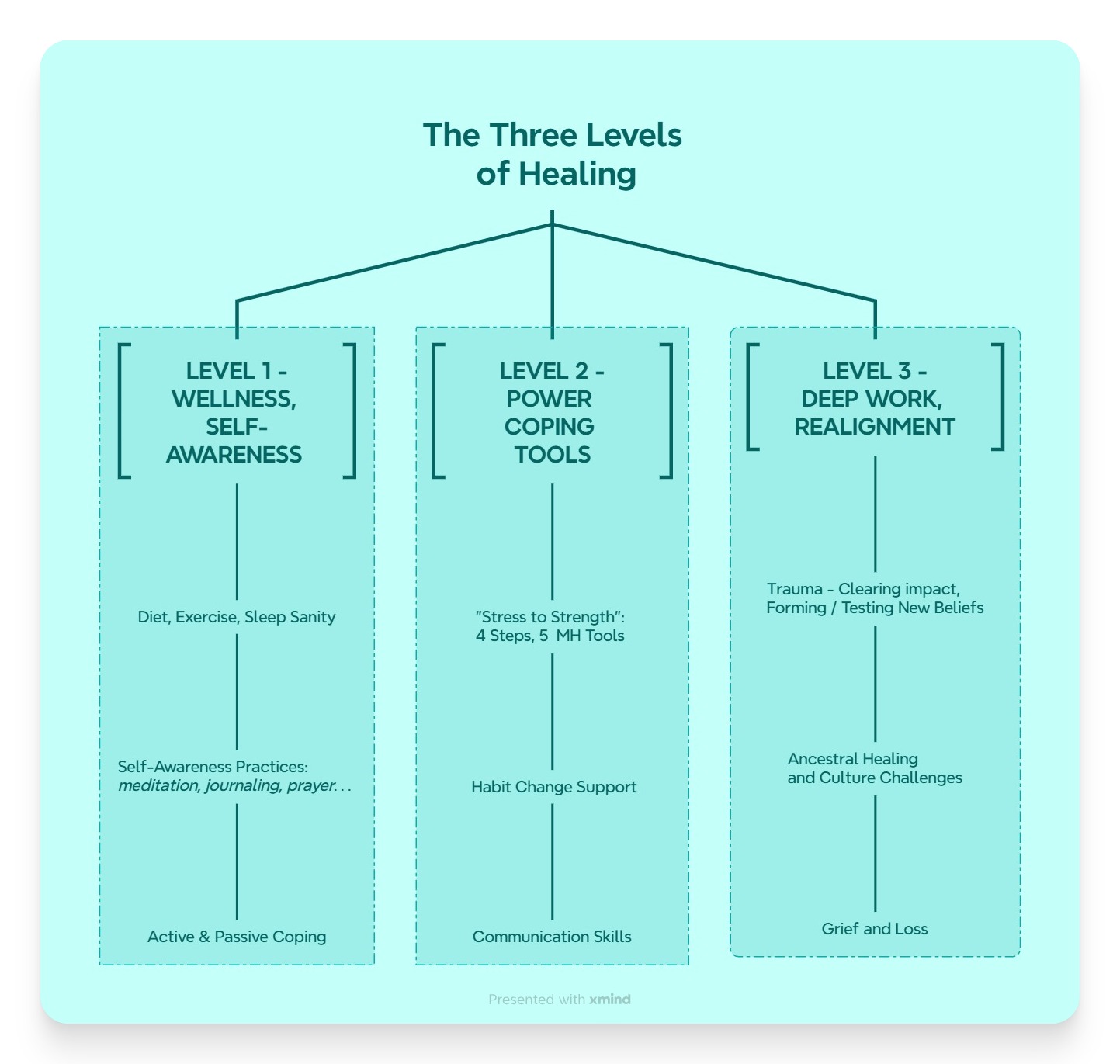
I like to think about healing in three levels. They’re not necessarily sequential, and we may move between them throughout our lives. But together, they offer a useful framework.
Level One: Stay Regulated and Take Care of Your Health.
This is our foundation. We need to give our bodies and minds the support they need to function well.
Some of the basics include:
- Getting consistent, restorative sleep.
- Taking care of our physical health.
- Finding ways to manage stress.
- Meditating or practicing mindfulness.
- Getting appropriate movement and time outdoors.
- Creating space for relaxation and enjoyment.
I know these things can sound rather basic, but they’re not insignificant. When we’re depleted, overwhelmed, or constantly operating in survival mode, it’s much harder to navigate life’s challenges.
Think of this level as creating the foundation that supports everything else. I mean, look at the benefits of exercise alone. Research has found that exercise can be comparable to antidepressant medication in reducing symptoms of non-severe depression. Take a stroll; it’s a great way to help you process emotions. They get breathing room, and you restore your perspective a bit. Think of it as letting your emotional intelligence get some air, or take a stroll …
Level Two: Use the Tools You’ve Learned.
Knowing what helps us regulate isn’t quite the same as actually using those tools when life gets difficult.
This is where we begin to put our knowledge into practice. We learn to recognize our triggers, pause before reacting, manage difficult emotions, and develop healthier ways of responding.
For example, rather than automatically reacting to a difficult conversation, we might take a breath, notice what’s happening inside us, and choose a more constructive response.
This level is about building the capacity to work with ourselves rather than constantly being at the mercy of our reactions. This is where practices help us offer our anxiety tea, instead of worrying more.
Level Three: Do the Deeper Work That’s Needed.
And finally, there is the deeper work.
This is where we look at the unresolved experiences, old wounds, and beliefs that may still be influencing how we live. It’s where we begin to understand why certain situations trigger us, why we repeat particular patterns, and what needs to change at a deeper level.
For some people, this may involve working with childhood experiences, relationship patterns, grief, trauma, or long-held beliefs about themselves.
This is also where having the right therapeutic support can make a significant difference. Sometimes we need someone who can help us see what we can’t quite see on our own, and guide us toward a different way of understanding and experiencing ourselves.
I believe all three levels matter. We need the foundation, we need the tools, and sometimes we need to go deeper to create lasting change.
Healing Is a Journey, Not a Formula
If there’s one thing I’d like you to take away from this series, it’s that healing is possible, but it requires some willingness to look at ourselves honestly.
We may need to stop avoiding something we’ve been pushing away. We may need to acknowledge unfinished business or question beliefs we’ve carried for years. And we may need to reconsider and update how we view the challenges that come into our lives.
But we don’t have to do it all at once, and we certainly don’t have to do it alone.
The process is different for everyone. Some things resolve with time, awareness, and the right tools. Other things need a little more attention and deeper support.
My hope is that you come away with a greater understanding of what might be getting in the way of your own healing, and a renewed sense of what’s possible.
And perhaps, the next time an unexpected visitor shows up at your door, you might have an inner smile when you see the furniture getting tossed about. Ah, more room for delight and expansion!
Wishing you blessings for the road.
Denise Barnes, LPC, REV, CSA
RESOURCES:
If you’d like to explore the earlier pieces in this conversation, you can start here:
How Trauma Impacts Deep Beliefs – and How to Change Them
How to Change Limiting Beliefs from Trauma, Part 2
Two great books; OK, three if I include mine 😍
No Regrets: A Ten-Step Program for Living in the Present and Leaving the Past Behind, Hamilton Beazley PH.D. The stories alone are mind-blowingly healing. The tools are evidenced-based and will help you for the rest of your life. Plus, he and I were born on the same day – winter solstice! We know how to navigate the path from dark to light.
The Tools: 5 Tools to Help You Find Courage, Creativity, and Willpower–and Inspire You to Live Life in Forward Motion, Phil Stutz and Barry Michel. I just started reading this one and the first tool is a beautiful and brassy solution to our tendency to stay in our comfort zone – what I call passive coping, versus the scarier (but oh so enlivening) active coping.
Stutz is a psychiatrist who started his practice in the 80s in Rikers Island prison, NY, then moved to LA. A client Jonah Hill helped make a documentary about him – which I had seen, but the book! Oh, the Book really shows off the tools! OK I do like to read – and there are a ton of illustrative stories – this is how the emotional brain really learns things.
Stress to Strength: A Therapist’s Guide to Empowering Clients, Denise Barnes. Not just for therapists, but for anyone who wants to learn to master their stress, and pivot faster through any triggers that arise. My team at Anchutz Cancer Center used these in clinical trials with cancer patients finishing treatment. The women dropped their levels of anxiety and stress by 50%!