Are You a Highly Sensitive Person? Why Sensitivity Is a Gift – and Courage Is Still Required
By Denise Barnes, Soul Savvy Coaching & Therapy
Let’s start with something most HSP descriptions don’t mention enough:
Sensitivity is a gift. And courage is still required.
If you’ve recently discovered you’re a Highly Sensitive Person — or an empath, or what I simply call a sensitive — you may have felt the enormous relief of finally having a framework that explains so much. The overwhelm. The need for recovery time. The way a critical comment or a worry can live rent-free in your nervous system for days. The exhaustion after a crowded event that others seem to bounce back from in minutes.
That relief is real, and it matters. Understanding your wiring is the foundation of finding your unique workarounds.
When the Framework Becomes a Cage
But here’s what I’ve watched happen — in my clients, in the spiritual community, and honestly, in myself at certain chapters of my life: the language of sensitivity can quietly become a shelter. A very understandable, very seductive shelter. Eventually though, the shelter can become a cage.
If you’ve ever said “I can’t do that — I’m too sensitive,” this post is for you.
What Is a Highly Sensitive Person? (The Original Definition)
The term Highly Sensitive Person was coined by research psychologist Dr. Elaine Aron in the mid-1990s. It describes a trait she called Sensory Processing Sensitivity (SPS). This person has a deeper, more thorough processing of sensory, emotional, and social information by the central nervous system.
Aron’s research identified four core characteristics, often summarized as D.O.E.S.:
- Depth of processing — you think deeply about everything, often connecting dots others miss
- Overstimulation — because you process so thoroughly, you hit a wall faster
- Emotional reactivity and Empathy — you feel more intensely, both the beautiful and the hard
- Sensitivity to subtleties — you notice what others walk right past: tone, texture, tension in a room
About 15–20% of the population carries this trait. It shows up across more than 100 animal species, suggesting it has genuine evolutionary value — sensitives have historically been the ones who notice danger early, read the room accurately, and keep the community safe. The fact that this trait is found in animals was compelling evidence to me.
This is not a disorder, nor a diagnosis. Rather, it is a trait. Kind of like being left-handed or having perfect pitch.
And, an important point I was reminded of – HSP is scientifically validated — Aron’s Sensory Processing Sensitivity scale has been replicated across numerous peer-reviewed studies, making HSP one of the most researched personality traits in psychology. That is not the case with the Empath situation, though it also makes sense.
HSP vs. Empath: What’s the Difference?
You may have encountered both terms and wondered which one fits — or whether they’re the same thing.
Psychiatrist and author Dr. Judith Orloff, whose book The Empath’s Survival Guide has become a touchstone for millions, draws a useful distinction. HSPs and empaths share a great deal: the low threshold for stimulation, the need for solitude to recover, the rich inner life, the deep attunement to others. But empaths, in Orloff’s framework, go further.
Where an HSP processes deeply, an empath can actually absorb the emotional and energetic states of others into their own body — often without a clear boundary between what belongs to them and what belongs to someone else. Some empaths also carry strong intuitive, spiritual, or even physical empathic abilities.
Orloff’s shorthand is elegant: “You increase the volume from HSP into empath.” A simple way to understand the relationship: All empaths are HSPs. Not all HSPs are empaths.
It’s a nested relationship, not a competition. One is not better, more evolved, or more spiritually advanced than the other. They are different expressions of sensitivity – and both are whole, complete, and genuinely needed in the world right now.
I hold both under the same umbrella: sensitives. People whose nervous systems are finely tuned instruments, capable of extraordinary perception, depth, and care.
A personal note here: thirty years of clinical practice required me to develop strong professional boundaries — and I believe that training quietly cleaned up whatever empathic bleeding I might otherwise have been prone to. Good boundaries are good medicine for sensitives. Psychic school training also frequently asks, is this energy mine or? And there’s a larger evolutionary current worth naming: as we collectively move away from people-pleasing and into more honest, boundaried communication, empathic permeability naturally becomes less of a liability. We become more porous by choice, less by default. That’s a significant shift.
Other points may transcend HSP/Empath land. In my view, sensitive or not, there are tasks that all of us humans are learning now. Maybe it is Earth’s evolution that is asking us: learn to work with conflict. Shift from too much people pleasing and hiding your truth or candor. Establish boundaries that are based in self-love before giving to others. Notice when you are avoiding what is meaningful, or what is stressful. Notice unhealthy escaping (some is OK). It’s time to wake up. It’s time to fully show up. HSP or Empath, warts and all.
Sensitivity and the Soul Picture
Just as earth evolution demands may override or add additional perspectives to sensitivity, there are other frameworks that are important to co-consider when you are looking at sensitivity. HSP never meant introversion or extroversion alone. Enter the adventure-seeking or high sensation seeking HSP. Also, soul missions may not give you a pass on needing to show up as a badass at times.
Let’s look at some other important features of soul savvy-ness in regard to sensitivity.
The Overlooked HSP: The Adventure Seeker
Dr. Aron also identified a subset of HSPs who carry a second trait alongside their sensitivity: High Sensation Seeking (HSS). This is the HSP who craves novelty, gets bored with routine, and feels a genuine pull toward new experiences, creative risk, and unexplored territory.
The HSP/HSS combination can feel like an internal tug-of-war. One part of you wants the new experience. Another part wants to process what it will mean, what could go wrong, and whether you’ll need three days to recover afterward. Until you understand both traits, this can feel like something is wrong with you.
Nothing is wrong with you. You are wired for both depth and adventure — and that is a potent combination when you learn to work with it.
The Pause Is the Superpower.
The key insight from Aron’s research: the HSP’s characteristic response to novelty is to pause and check, not to avoid. That pause is not weakness. It’s wisdom. Discernment. The sensitive person who researches the solo trip for six months before booking it and then has the most profound experience of her life? That’s the adventure seeking HSP/HSS in action.
Pause to check. Then go.
Why Sensitivity Can Become a Hiding Place
This is the part I care most about — because I’ve seen it too many times, and I’ve lived some version of it myself.
The discovery of the HSP trait often comes during a period of exhaustion, burnout, or deep frustration with a world that seems designed for people wired differently than you. The framework arrives like a life raft. And it is. But life rafts are for getting to shore — not for living on indefinitely.
When sensitivity becomes identity rather than context, something shifts. “I’m an HSP” can quietly become:
- I can’t handle that kind of visibility.
- Networking is too much for me.
- Speaking up in that room would be overstimulating.
- Putting myself out there – performing, launching, leading – isn’t for people like me.
I want to say this clearly and with full compassion: the HSP framework never said that. Dr. Aron’s research consistently points to sensitives as natural leaders, wise advisors, creative visionaries, and exactly the kind of people communities need at the front of the room.
The nervous system activation you feel when you stretch beyond your comfort zone? That is real. Moreover, it is workable. The tools exist, and the capacity is already in you.
My Own Story: When the Performer Showed Up Anyway
I am a therapist and coach by vocation — an Advisor, in the language of the Sparketype framework (a powerful assessment I use in my Radiant Work Coaching to help clients identify or update their soul-level work). Advising, guiding, holding space — that’s the primary current running through everything I do.
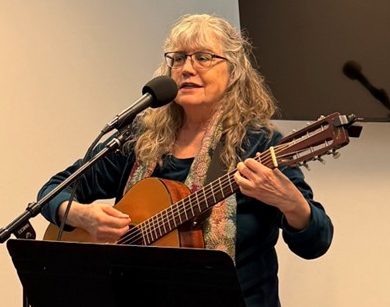
But I also have a Performer as my secondary Sparketype. And for a long time, that part of me stayed quiet. Or, I’d bounce back and forth, like one can do when you have different sides and different longings.
Performing — whether on a stage, in front of a camera, or in any moment of genuine visibility — activates my nervous system. I feel it. Stress climbs as I prepare even though I have performed forever. Every sensitive person in a performance context knows exactly what I’m talking about: the higher stress of preparing, the internal amplification, the courage to keep stepping toward the show, the feel-good exhaustion after.
When Soul Overrides Sensitivity
I could have called that sensitivity and stayed small. I do recall reading somewhere that HSPs shouldn’t even consider public speaking. Wonder what the experts would say about doing comedy?!
Instead, I kept showing up to it. I kept building my music life, my performance presence, my willingness to be seen. Not because the fear disappeared — it hasn’t entirely — but because I understood that the stretching was the path. That my soul’s work required the full palette, not just the parts that felt safe. So that’s a point to add in here – the soul has a say too.
The Stress to Strength tools I teach my clients are the same tools I use in my own green room moments: nervous system regulation, grounding, the curiosity about what old pattern wants to be freed. The tools don’t eliminate the sensitivity. They make it workable. They help me support myself in following what’s important, what’s real to do.
That’s what I want for you.
The Times Are Asking More of Us
We are living in a moment that genuinely calls for sensitive people to step forward — not retreat.
The world needs people who can feel what’s happening beneath the surface. Who can hold complexity without collapsing. Leaders with both rigor and compassion. Clear ones who notice the things that others walk past.
That is you. That has always been you. That difference others have noticed is what makes this time yours.
The evolutionary research on the HSP trait is worth sitting with here: sensitives have historically been the ones who protected the group, who read the environment accurately, who sounded the alarm before the danger arrived. This is not a trait designed for hiding in a quiet room forever or avoiding speaking your truth. It is a trait designed for attunement in service of something larger.
Playing small is not self-care. It might feel like it in the short term – and sometimes genuine rest and recovery truly are what’s needed. But there is a difference between restoration and avoidance dressed up as restoration.
Only you know which one you’re in.
What Radiant Livelihood Looks Like for a Sensitive
In my work with HSPs and soulful professionals in midlife, the path from depletion to what I call Radiant Livelihood — work that energizes, serves, and pays well — almost always involves some version of this:
- Understanding your wiring — naming the trait, relieving the shame, building genuine self-compassion
- Learning your nervous system — tools that regulate, restore, and build capacity over time
- Facing the stretch — identifying where sensitivity, past trauma or ancestral wounds have blocked expansion, and taking the next courageous step anyway
- Doing the deeper work — clearing the ancestral and trauma patterns that create invisible ceilings on expansion
The sensitive people who thrive are not the ones who stop being sensitive. They are the ones who stop apologizing for it — and stop hiding behind it.
If you’d like to explore your own version of this, I invite you to take the Sparketype Assessment (it’s free and quick) as a starting place for understanding the work that is most alive in you. And if you’re ready to go deeper, I’d love to talk.
You Are Built for This Moment
You feel things deeply. You process thoroughly. You notice what others miss.
Those are not liabilities to manage. They are assets to employ.
The world does not need you smaller. It needs you grounded, regulated, courageous — and fully, unapologetically present.
Sensitivity is the gift.
Courage is still required.
And you have both. A killer combo in dangerous times. Funny that – the revolution will look very different with sensitives holding the flags…
RESOURCES FOR RADIANT LIVELIHOOD and COURAGEOUS SENSITIVITY:
The Sparketype Assessment, developed by Jonathan Field of the Good Life Project
Book by Judith Orloff, The Genius of Empathy: Practical Skills to Heal Your Sensitive Self, Your Relationships, and the World
Book by Tom Rath, What’s the Point: Turning Purpose into your Daily Superpower. I’ve written a Soul Savvy Courage story about Tom Rath.
Denise’s book on healthy coping for therapists and sensitives alike, Stress to Strength: A Therapist’s Guide to Empower Clients
FREE WEBINAR ON Thursday 5/28 AT 3PM MTN TIME
Soul Savvy AI: Harnessing AI with Heart Power
Blog: Healthy AI use for HSPs: A Heart Centered Perspective
Denise Barnes is a Life & Career Coach, Intuitive Guide, and Licensed Psychotherapist with 30+ years of experience, including oncology counseling. Her Soul Savvy coaching model guides Highly Sensitive Persons and soulful professionals from burnout and stuckness to Radiant Livelihood — careers and lives that energize, serve, and pay well. Learn more at soulsavvy.net or book a complimentary conversation at calendly.com/denisebarnes/30min.
Blog Photo by visualsofdana on Unsplash
Discover more from Soul Savvy
Subscribe to get the latest posts sent to your email.